Timing by species, not by calendar
Spring bloomers set their flowers on last year’s wood, so shearing a forsythia or lilac in March is how you get a green shrub and no flowers. Those get cut right after they bloom.

Overgrown shrubs are not just a look. Pressed against siding they hold moisture against the house, they block the light out of the windows behind them, and they give everything that wants into your foundation a place to sit unnoticed. Cutting them back correctly means cutting to a branch or a bud that can take over — not shearing the outside into a shape and leaving a hollow, woody, leafless middle.
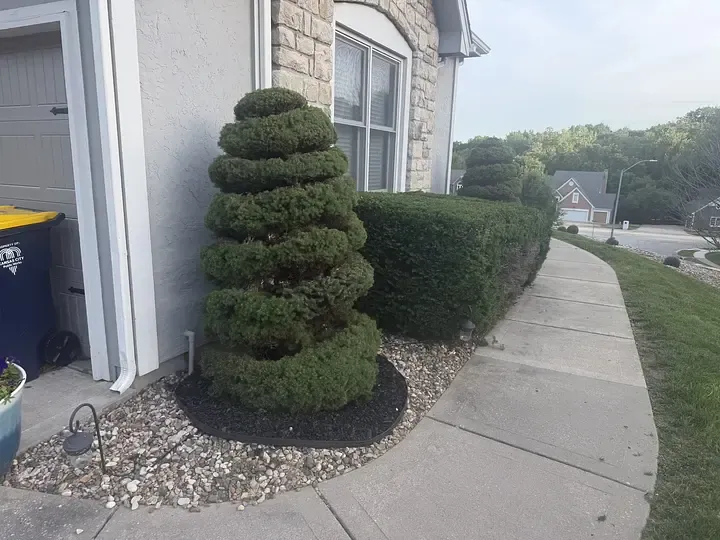
Spring bloomers set their flowers on last year’s wood, so shearing a forsythia or lilac in March is how you get a green shrub and no flowers. Those get cut right after they bloom.
We take some cuts back inside the plant so light and air get to the center. It is what keeps a shrub full instead of a green shell over bare sticks.
Shrubs pulled back off the siding, out of the gutters and away from windows and walks. Foundation plantings should be a foot clear of the wall.
Some foundation shrubs are thirty years old and four feet too big. Taking them out and replanting is often cheaper than three more years of trying to shrink them.
Ornamental and small trees we can work from the ground are ours. Anything large, or anything overhanging a house, a fence, a line or a neighbor, is not. That work needs a climber, a crane and a different insurance policy, and we will tell you so rather than take it on.
Most of our customers book two or three of these together — it is cheaper than separate visits and it all gets done the same day.
Booked most often in these communities — and available in all 64 we cover.
Most deciduous trees and summer-blooming shrubs are best pruned in late winter while they are dormant — the structure is visible and the plant heals fast in spring. Spring-flowering shrubs get pruned right after they finish blooming. Broken, dead or hazardous limbs come off whenever we find them.
No. We work on small and ornamental trees and on shrubs — the things we can reach and handle safely from the ground. Large trees, and any tree overhanging a house, fence, power line or a neighboring property, are outside what we take on. That is climber-and-crane work and it needs a licensed tree service. If your job turns out to be one of those, we will say so instead of attempting it.
Yes, and the question we start with is how big the spot is, not which plant you like. Half the overgrown foundation beds we redo failed because something that wants to be eight feet wide was planted three feet off a wall.
The person who walks your property and gives you the price is the person doing the work — five years of it across this metro. Nothing is handed to a subcontractor and nothing is quoted by someone who will never see the job. If any part of the finished work is not what we agreed, tell us and we come back and put it right. That is the whole guarantee, and it is easy to stand behind when one person is accountable for every job.
Free estimate, no obligation. Call (816) 813-3543 or send the form and we will come look at the property.