What clay does that sand does not
Clay particles are microscopic and flat, so they pack together with very little air between them. That gives you three properties that matter in a yard: it compacts under any load and stays compacted, it holds water rather than letting it drain through, and it swells when wet and shrinks when dry. The last one is the killer. Ground that changes volume with moisture is ground that moves things sitting on it, and in Kansas City it goes through that cycle repeatedly every winter as it freezes and thaws.
Why patios heave and walls lean
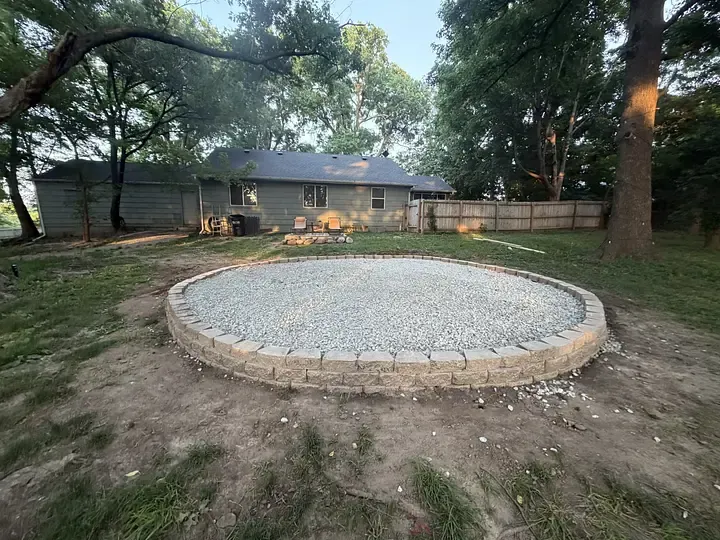
A paver patio is only as stable as what is under it. If the base is too thin, or the aggregate was dumped in one deep layer and rolled once instead of compacted in lifts, there are soft spots. Water gets into those, freezes, expands, and pushes the surface up. It looks perfect the first autumn and shows a dip or a ridge by March. A retaining wall fails the same way from behind: saturated clay pressing on the back of a wall is an enormous, relentless load, and if there is no drainage stone and no drain line giving that water somewhere to go, the wall eventually tips forward. Neither failure is about the quality of the block.
Why beds drown and lawns run off
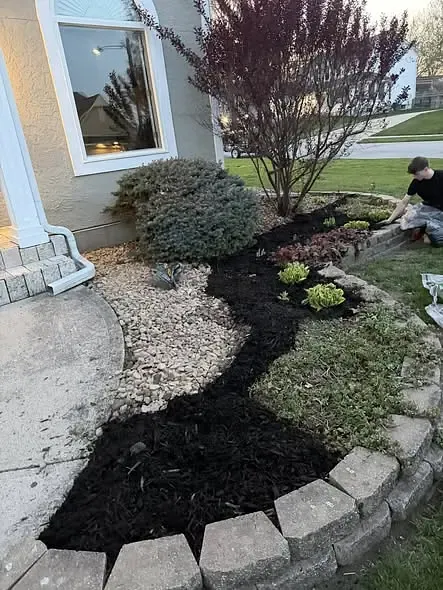
Digging a planting hole in clay and backfilling it with nice loose compost creates a bowl — water flows in through the soft soil, hits the hard clay wall, and sits there. Plants in that hole drown slowly over a season or two. On lawns the opposite problem shows up: compacted clay sheds water so fast that a heavy rain mostly runs off into the street, while the roots underneath stay dry and shallow. That is why a KC lawn can be watered regularly and still look thin.
What actually works
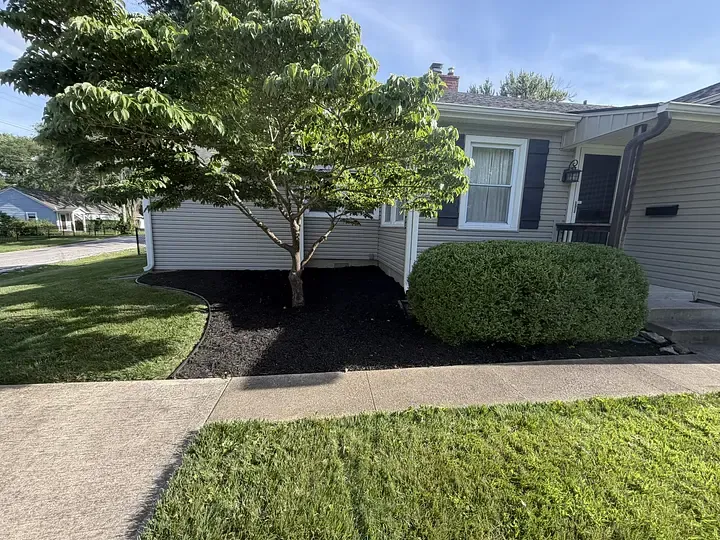
Excavate and compact hardscape bases in layers, not in one lift. Put clean angular drainage stone and a working drain line behind every retaining wall. Build beds so they shed water outward rather than sitting in a dug bowl, and improve a whole bed area rather than one plant-sized hole. Core-aerate lawns in autumn so water and air have a route down. And use river rock instead of mulch wherever runoff concentrates — downspout lines, foundation strips, the low side of a slope — because mulch in those places is a thing you replace every year.
The honest test of a landscaper here
Ask what goes under it and how it drains. If the answer to a patio is about paver color and not about base depth and compaction, or the answer to a wall does not mention drainage stone, you have learned something useful. The parts of this work that determine whether it survives five winters are all invisible by the time the job is finished.
None of this makes clay a problem you cannot build on. It just means the preparation is the job, and the pretty part is the last ten percent.